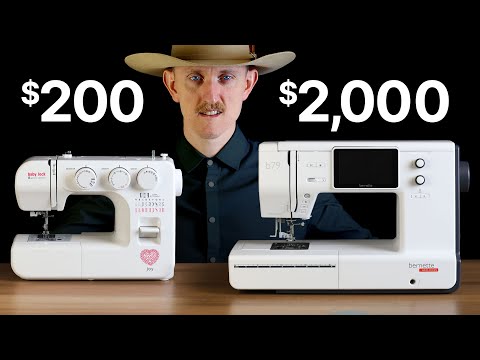
Save 10% on sewing machines and supplies over at Quality Sewing with code CORN at checkout →
———
👩🎓 — My Pattern Drafting Courses →
💸 — Join the Club →
🧵 — Shop Sewing Essentials →
✉️ — Newsletter →
📱 — Website →
✂️ — Get my Scissors Gift Set →
———
00:00 — Introduction
00:46 — What Do You Want
to Sew?
05:51 — What Features Matter?
09:20 — What Brand?
10:28 — How Much Money?
12:43 — What Really Matters?
———
Choosing a sewing machine can feel overwhelming—so many brands, so many features, so many price points. But don’t worry, I’ve got you covered. In this video, I break it all down to help you figure out exactly what machine will work best for your needs.
We start by answering the biggest question: What do you want to sew? From garment-making to quilting, heavy-duty projects to delicate details, different machines excel at different things. Are you sewing regular clothes? A “standard” sewing machine with a straight stitch and zigzag will cover most of your needs. Planning on sewing a lot of knit fabrics? You might want a serger (or overlocker) for those stretchy seams. Going all-in on heavy-duty projects? A semi-industrial machine might be the answer.
Then we get into the fun stuff—features and extras. Automatic thread cutters, knee-lift presser feet, fancy buttonholes… do you need them? Maybe. Do you want them? Probably. And let’s talk budget—how much should you spend, and is it worth saving up for that slightly better machine? (Spoiler: Yes. It usually is.)
If you’re in the market for a new sewing machine, this video will help you make the best choice for your projects. Let me know in the comments—what machine are you using right now, and what’s your dream upgrade?
I Love my Pfaff, got it when when I started sewing. Then bought a Bernina quilting machine(which I love) and discovered the Pfaff had a better straight stitch(go figure). So, depending on what I wanted, I would just switch up machines.
Either way I’m happy with both. By the way, I’ve had these machines since the mid 90s and the Phaff I purchased second hand.
Have a great day!!
i make custom wide brim hats i’m still looking for a good sewing machine that can be finr with fur felt
Yup, decided to get a machine slightly above my budget… and by slightly above I mean double the price 😬
Short answer… buy 3.
I feel like all these people are selling a bill of sale that isn’t exactly true. 20 + years ago I fell into this “I need the fanciest machine” idea… I was young, saved for a year to buy the Pfaff I really wanted, back when they were still made in Germany and not by SVP which is the private equity that now owns them along with Singer and Viking too. I was trying to sew silk with only 1/8th inch seam allowance, I couldn’t for the life of me not get that machine to not eat the fabric, sucking it down into the bobbin carriage… a call to my Mother, she said switch to a straight stitch plate (that means instead of that big oval hole that allows for all the fancy stitches, it is just one small hole just big enough for the needle to pass through).. well, even as nice as my machine was, it wasn’t an option. I remembered my Grandmother’s Singer model 15 I had saved from the barn years before was a straight stitch machine… I had never used it, never sewed on it… not sure I had ever even plugged it in. I cleaned it up (something I had been intending for years to do), oiled and greased it. Thought this is never going to work, threw that silk fabric on there… that machine sewed it like a dream and it didn’t creep either (if you ever sewed silk or satin you know what I mean by creeping), keeping in mind this machine had sewed all my Grandmothers clothes for decades, she even said my Dad and his two brothers never had store bought clothes, she sewed all their clothes and this thing had set in a unheated barn for over a decade. I started sewing more and more on this 1944 Singer model 15… the more I did, the more I enjoyed it and actually enjoyed sewing more. New machines are so finicky, they will decide to fight you any chance they get, tension nightmares and bird nesting parties! My advice, take $20 to a thrift store… you may have to look for a bit, but I see them all the time… buy a vintage straight stitch machine. Yes, everyone gets all romanced by all these machines that will do all these stitches, I can tell you 99% of sewing is straight stitch, you will never use all these stitches you think you just have to have… maybe once, when you first get the machine and are playing around with it, but besides that, you will never use them again! ZigZag can be important with certain fabrics, but guess what, for around $10 to $20 you can find zigzag feet attachments for vintages straight stitch machines, even button holer’s. The other big secret they won’t tell you… ALL these new machines are built with nylon gears, which they will tell you if you are smart enough to know that and ask, is so you don’t have to grease the machine and so it runs smoother.. what it really is, it is planned obsolescence. Those nylon gears will eventually wear out, I don’t care if it is a $100 or $8000 machine, they will ware out… sure, you can get it repaired, but wait until you see the repair bill! So a couple of decades ago, I started sewing using an almost 70 year old machine, to this day, the machine is over 80 years old now, it still sews like a dream. If you are new to sewing, there are other pluses of a vintage machine, they are simple to use, easy to thread and that finicky tension of new machines doesn’t happen on old machines… I think my 15 is set on about 4 and stays there, it will sew satin and denim without even changing it. It is really hard, even me, who loves these old machines to not fall into this trap… about 10 years ago I threw out $5K on a new Janome… I wish every time I see it I didn’t waste my money, it just sits in the corner waiting. My two main machines today are my Singer 15 and 201… The other fun thing they won’t tell you, these old machines will out work new machines any day of the week… he talked about the semi-commercial machines, I promise you my 201 can out perform that new machine. I just recovered a vintage leather ottoman that was covered in piping as part of its designs, some of the seams I was sewing through 6 layers of upholstery leather, that old ass 201 acted like it was nothing, just sewed right through it, the motors in vintage machines are way stronger. A lot of new machines the bobbin lay’s horizontal, any expert will tell you, that is for convenance, for the best stitches a bobbin needs to be sitting upright, on its side the thread twists as it sews when it is on its side… there is a reason commercial machines the bobbins still sit upright in bobbin carriages like old machines. It is also a quality thing… you don’t even have to find a Singer… most old machines will be made 1000 times better than any new machine. Some people even say the Japanese model 15 knock offs are even better than the actual Singer… a lot of them have the option to lower the feed dogs, Singer never had that on the 15. I think De Luxe is a pretty good Japanese brand, FYI De Lux is Brother today… you will see a lot of them out there, sometimes they are called something else, but if you look on the base near the table, it will often times still say De Lux. FYI, you will see machines called New Home, those are actually Janomes. Kenmore machines are a little trickier… if you find one and it said made in Japan, then it is probably great… but if it is made in China with a plastic shell, walk away! LOL! The thing is, most of these old machines are a pleasure to sew on, if something does break you can usually fix it… one, because the manuals are very detailed, they even often times show you how to take the machine apart… and no computers on them to blow up and cost you a fortune to fix!